Zeus vs Poseidon: Comparing Business Strategies
For instance, a study comparing different leadership styles found that those who adapt their approach to the situation tend to achieve better outcomes. This adaptability is a hallmark of strategic leadership, enabling businesses to respond effectively to challenges and opportunities.


18 min read
In the world of mythology, Zeus and Poseidon are two powerful figures with distinct approaches to achieving their goals. Comparing their methods can provide valuable insights into effective business strategies.
The way Zeus ruled the skies and Poseidon commanded the seas can be seen as metaphors for different approaches to leadership and management. By examining their contrasting styles, entrepreneurs and business leaders can gain a deeper understanding of what works best for their organizations.
Understanding the strengths and weaknesses of different business approaches is crucial in today’s competitive landscape. This article will delve into the strategic differences between Zeus and Poseidon, exploring how their mythological exploits can inform modern business decisions.
Key Takeaways
- Understanding different leadership styles is crucial for business success.
- Mythological figures can provide valuable insights into effective business strategies.
- Contrasting approaches to management can help entrepreneurs make informed decisions.
- Examining the strengths and weaknesses of different business approaches is essential.
- Strategic differences between mythological figures can inform modern business practices.
The Divine Blueprint: Understanding Business Strategy Fundamentals
Developing a robust business strategy is akin to crafting a divine blueprint for success in the corporate world. In today’s competitive landscape, entrepreneurship strategies play a crucial role in determining a company’s trajectory. A well-crafted strategy not only guides decision-making but also aligns the organization towards common goals.
Defining Strategic Leadership in Modern Business
Strategic leadership is about making informed decisions that drive business growth. It involves a deep understanding of the market, competitors, and internal capabilities. Effective strategic leaders are adept at navigating complex business environments, leveraging best business practices to stay ahead.
For instance, a study comparing different leadership styles found that those who adapt their approach to the situation tend to achieve better outcomes. This adaptability is a hallmark of strategic leadership, enabling businesses to respond effectively to challenges and opportunities.
| Leadership Trait | Description | Impact on Business |
|---|---|---|
| Visionary | Sets long-term goals and direction | Provides clarity and focus for the organization |
| Adaptive | Adjusts strategies based on market feedback | Enhances resilience and competitiveness |
| Innovative | Encourages creativity and new ideas | Drives growth through new products or services |
Mythological archetypes, such as Zeus and Poseidon, offer powerful metaphors for understanding different leadership styles and business strategies. By examining these archetypes, business leaders can gain insights into effective entrepreneurship strategies and how to apply them in real-world contexts.
For example, Zeus’s authoritative leadership style can be seen in centralized management structures, while Poseidon’s adaptive nature reflects the flexibility needed in dynamic markets. Understanding these archetypes can help leaders choose the most appropriate strategies for their business challenges.
Olympian Overview: Zeus’s Leadership Style
As the supreme ruler of Mount Olympus, Zeus’s leadership style is a compelling case study for business strategy comparison. His approach to authority and hierarchy offers valuable insights into effective leadership structures.
The Sky God’s Approach to Authority and Hierarchy
Zeus’s leadership is characterized by a centralized authority, where decision-making power is concentrated at the top. This approach has both benefits and drawbacks.
Centralized Decision-Making Benefits
A centralized decision-making process allows for swift and decisive action, as seen in Zeus’s ability to control the weather with his thunderbolts. This decisiveness is a significant advantage in fast-paced business environments.
When Top-Down Leadership Falls Short
However, a top-down approach can also lead to detachment from the needs and concerns of lower-ranking team members. In business, this might result in products or services that don’t meet customer needs.
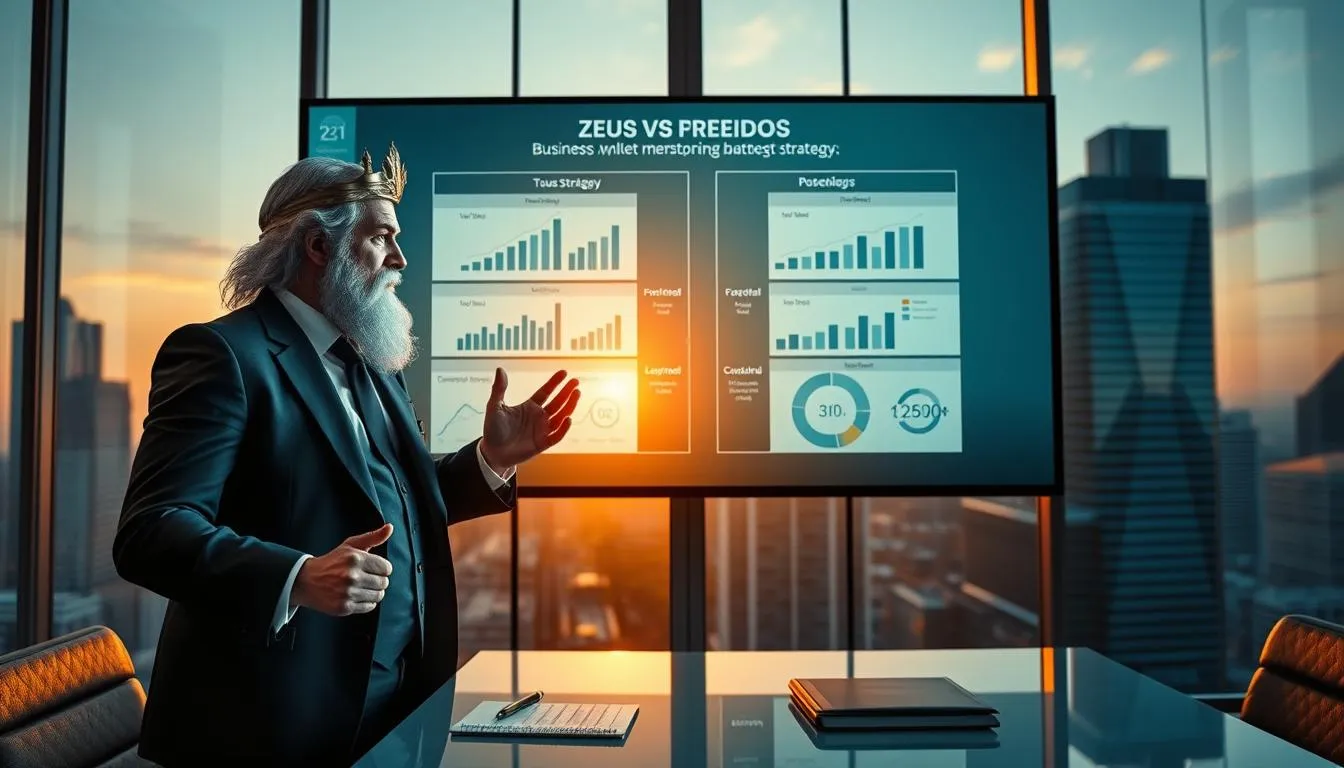
Zeus’s Strategic Vision: Long-Term Planning vs. Reactive Management
Zeus is known for his long-term strategic vision, often planning several moves ahead. This strategic thinking is crucial in entrepreneurship strategies vs reactive management.
| Leadership Aspect | Zeus’s Approach | Business Application |
|---|---|---|
| Decision-Making | Centralized | Swift action in critical situations |
| Strategic Vision | Long-term planning | Proactive approach to market changes |
Maritime Management: Poseidon’s Business Philosophy
The Sea God’s business philosophy, as reflected in his maritime management techniques, presents an intriguing alternative to traditional leadership models. By examining Poseidon’s approach to governing the oceans, we can gain valuable insights into effective business strategies, particularly when comparing startup strategies.
The Sea God’s Fluid Approach to Organizational Structure
Poseidon’s maritime management style is characterized by its fluidity and adaptability. This approach allows for a more responsive and agile organizational structure, which is crucial in today’s fast-paced business environment.
Adaptability as a Competitive Advantage
One of the key benefits of Poseidon’s fluid approach is its ability to adapt quickly to changing circumstances. This adaptability provides a competitive advantage, enabling businesses to respond effectively to new challenges and opportunities.
Balancing Flexibility with Consistency
While adaptability is crucial, it’s equally important to maintain consistency in business operations. Poseidon’s approach demonstrates the need to balance flexibility with stability, ensuring that the organization remains cohesive and focused.
Poseidon’s Emotional Intelligence in Leadership
Poseidon’s leadership style also highlights the importance of emotional intelligence in managing a diverse and complex organization. By understanding and empathizing with the needs of his underwater kingdom’s inhabitants, Poseidon fosters a loyal and motivated team.
In conclusion, Poseidon’s maritime management philosophy offers valuable lessons for businesses, particularly in terms of adaptability and emotional intelligence. By embracing these principles, organizations can develop more effective and responsive leadership strategies, ultimately leading to best business practices.
Resource Allocation: How Zeus and Poseidon Manage Their Domains
The way Zeus and Poseidon manage their respective domains offers valuable insights into different resource allocation strategies. Effective resource allocation is a critical component of successful business strategy, and the approaches of these two gods provide contrasting models for entrepreneurs and business leaders.
Zeus’s approach to resource allocation is characterized by a centralized distribution model. This method allows for a more controlled and coordinated allocation of resources across his domain.
Zeus’s Centralized Resource Distribution Model
Zeus’s centralized model enables him to maintain a tight grip on his resources, ensuring that they are allocated efficiently to achieve his strategic objectives. This approach is particularly effective in stable environments where predictability is high. The advantages of this model include:
- Enhanced control over resource allocation
- Improved coordination across different departments
- Better alignment with overall strategic objectives
Poseidon’s Territorial Expansion Strategy
In contrast, Poseidon’s territorial expansion strategy involves allocating resources to expand his domain, often through strategic acquisitions or investments in new territories. This approach allows for flexibility and adaptability in a rapidly changing environment. The benefits of Poseidon’s strategy include:
- Increased market share through strategic expansion
- Diversification of resources and revenue streams
- Enhanced ability to respond to changing market conditions
Both Zeus’s and Poseidon’s strategies have their merits, and the choice between them depends on the specific business context and goals. By understanding these different approaches to resource allocation, business leaders can make more informed decisions about how to manage their own resources effectively.
Business Strategy Comparison: The Olympian Boardroom vs. The Oceanic Enterprise
In the realm of business strategy, the contrast between Zeus’s Olympian approach and Poseidon’s oceanic methodology offers valuable insights. As we delve into the business strategies employed by these two mythological figures, we can identify key differences in their approaches to expansion and risk management.
Vertical Integration vs. Horizontal Expansion
Zeus’s Olympian domain exemplifies vertical integration, where control is maintained over various aspects of the business, from production to distribution. This approach allows for greater control over the quality and cost of products or services.
In contrast, Poseidon’s oceanic empire demonstrates horizontal expansion, where the focus is on increasing market share through diversification and territorial growth. This strategy enables businesses to tap into new markets and customer segments.
| Strategy | Zeus’s Approach | Poseidon’s Approach |
|---|---|---|
| Expansion Method | Vertical Integration | Horizontal Expansion |
| Key Benefits | Control over quality and cost | Increased market share and diversification |
The risk assessment approaches of Zeus and Poseidon differ significantly, reflecting their unique domains and leadership styles.
Zeus’s Calculated Risk-Taking
Zeus’s approach to risk involves calculated risk-taking, using his control over the skies to anticipate and prepare for potential threats. This strategic foresight enables Zeus to mitigate risks effectively.
Poseidon’s Opportunistic Ventures
In contrast, Poseidon’s risk assessment is characterized by opportunistic ventures, where he leverages his control over the seas to capitalize on emerging opportunities. This approach allows Poseidon to adapt quickly to changing circumstances.
By comparing these two approaches, businesses can gain insights into the merits of different risk management strategies and choose the one that best suits their needs.
Innovation Approaches: Divine Invention vs. Oceanic Adaptation
The divine invention approach of Zeus and the oceanic adaptation strategy of Poseidon provide a fascinating comparison for business leaders seeking innovation. In the business world, innovation is crucial for staying ahead of the competition, and different approaches can lead to varying degrees of success.
 Zeus’s and Poseidon’s methodologies represent two distinct paths to innovation, each with its strengths and weaknesses. Understanding these approaches can help businesses choose the most suitable strategy for their needs.
Zeus’s Disruptive Innovation Style
Zeus’s approach to innovation is characterized by disruptive, game-changing ideas that revolutionize markets. This style involves significant investment in research and development, a willingness to take risks, and the ability to implement new technologies or processes quickly. For instance, companies like Tesla have successfully employed disruptive innovation by introducing electric vehicles that have transformed the automotive industry. According to a report on climate change mitigation, innovative technologies play a crucial role in reducing emissions and achieving sustainability goals.
Poseidon’s Adaptive Evolution Strategy
In contrast, Poseidon’s adaptive evolution strategy focuses on gradual, incremental improvements to existing products or services. This approach involves closely monitoring market trends and customer feedback, then adapting offerings accordingly. It’s a more flexible and responsive method that allows businesses to navigate complex and changing environments effectively. Companies like Apple have used this strategy to iteratively improve their products, maintaining market leadership through continuous adaptation.
| Innovation Aspect | Zeus’s Disruptive Style | Poseidon’s Adaptive Strategy |
|---|---|---|
| Approach to Innovation | Disruptive, game-changing | Gradual, incremental |
| Risk Level | High | Moderate |
| Investment Focus | R&D, new technologies | Market research, customer feedback |
| Market Impact | Revolutionary | Evolutionary |
Talent Management: Assembling Your Divine Team
In the realm of business, assembling a talented team is akin to gathering divine forces in Greek mythology. Effective talent management is crucial for the success of any organization, and leaders can learn from the approaches of Zeus and Poseidon.
Zeus’s Approach to Recruitment and Delegation
Zeus, known for his authoritative leadership, employed a strategic approach to recruitment and delegation. He identified key talent among the gods and mortals alike, assigning tasks that aligned with their strengths.
Identifying and Developing Key Talent
Zeus focused on recognizing potential in individuals and nurturing it. This involved strategic mentoring and providing opportunities for growth.
Creating Accountability Structures
To ensure accountability, Zeus established clear roles and responsibilities, leveraging his divine authority to enforce compliance.
Poseidon’s Method for Building Loyal Followers
Poseidon, on the other hand, built his power base by fostering loyalty among his followers. His approach was more about creating a cohesive unit rather than just assigning tasks.
Fostering Team Cohesion Through Shared Purpose
Poseidon’s strategy involved aligning his followers with a common goal, enhancing their sense of belonging and commitment.
Empowering Middle Management
By empowering the middle tier of his organizational structure, Poseidon ensured that his directives were carried out effectively, with a clear line of command.
Comparing these two approaches can provide valuable insights into effective talent management. The following table summarizes the key differences:
| Aspect | Zeus’s Approach | Poseidon’s Approach |
|---|---|---|
| Recruitment Focus | Identifying individual talent | Building a loyal team |
| Delegation Style | Task-oriented | Empowerment-focused |
| Accountability | Authority-based | Shared purpose-driven |
Crisis Management: Weathering Storms and Challenges
Crisis management is a critical aspect of business strategy, with Zeus’s top-down approach and Poseidon’s adaptive response offering two distinct methodologies. Effective crisis management can make the difference between a business’s survival and downfall.
In the face of adversity, leaders must decide whether to adopt a centralized, authoritative approach or a more flexible, adaptive strategy. Zeus’s top-down problem-solving approach is characterized by swift decision-making and a clear chain of command, while Poseidon’s adaptive response to threats involves flexibility and a willingness to adjust strategies as circumstances evolve.
Zeus’s Top-Down Problem-Solving Approach
Zeus’s method is exemplified by his control over the skies and his ability to wield powerful thunderbolts. This approach is beneficial in situations requiring immediate action and decisive leadership.
- Clear Chain of Command: Ensures that decisions are made quickly and executed without delay.
- Decisive Action: Allows for swift responses to emerging crises, minimizing potential damage.
- Centralized Control: Enables Zeus to maintain overall control and direction during turbulent times.
Poseidon’s Adaptive Response to Threats
In contrast, Poseidon’s adaptive strategy involves a more nuanced approach to crisis management, focusing on flexibility and the ability to adjust to changing circumstances.
- Flexibility: Poseidon’s approach allows for adjustments in strategy as the situation demands.
- Emotional Intelligence: Understanding the emotional currents within an organization can help in navigating complex crises.
- Resilience: Building resilience within the organization enables it to withstand and recover from challenges.
Both Zeus’s and Poseidon’s strategies have their merits and drawbacks. The key to effective crisis management lies in understanding when to apply each approach, depending on the nature of the crisis and the organizational context.
 By comparing these two divine strategies, business leaders can gain valuable insights into how to navigate their own crises, leveraging the strengths of both top-down authority and adaptive flexibility.
Modern Applications: Implementing Divine Strategies in Today’s Business Landscape
As we navigate the complexities of modern business, the contrasting strategies of Zeus and Poseidon offer a fascinating lens through which to examine our own approaches. The leadership styles of these two mythological figures can be applied to various business environments, providing insights into effective management and strategic planning.
Industries That Thrive Under Zeus-Style Leadership
Zeus’s authoritative and strategic approach can be particularly effective in industries that require strong hierarchical structures and long-term planning. Industries such as technology and manufacturing often benefit from this style of leadership.
Tech Giants and Manufacturing Sectors
In the tech industry, companies like Microsoft and Google have demonstrated the value of strong strategic leadership, similar to Zeus’s approach. For instance, Satya Nadella’s leadership at Microsoft has been characterized by a strong vision and strategic planning, echoing Zeus’s style. Manufacturing sectors also benefit from Zeus’s approach, as seen in companies like General Electric, where a centralized and hierarchical structure can enhance efficiency and productivity.
Implementing Zeus’s Strategic Planning in Your Organization
To implement Zeus’s strategic planning, businesses should focus on developing a clear, long-term vision and establishing a strong hierarchical structure. This involves strategic management practices that prioritize decision-making at the top levels of the organization, ensuring a unified direction and efficient resource allocation.
Business Environments Where Poseidon’s Approach Excels
Poseidon’s adaptive and emotionally intelligent leadership style is particularly suited to dynamic and rapidly changing business environments. Startups and creative industries often thrive under this type of leadership.
Startups and Creative Industries
Startups, such as those in the tech incubator scene, benefit from Poseidon’s adaptability and ability to navigate uncertain waters. Creative industries, like advertising and design, also flourish under Poseidon’s style, as it encourages innovation and flexibility. For example, companies like IDEO have successfully adopted an adaptive approach to product design, reflecting Poseidon’s emphasis on creativity and responsiveness to change.
Adopting Poseidon’s Adaptability in Changing Markets
To adopt Poseidon’s adaptability, businesses should cultivate an organizational culture that values flexibility and emotional intelligence. This involves fostering a work environment where employees are encouraged to be responsive to changing market conditions and customer needs, much like Poseidon’s ability to control the seas and adapt to its moods.
| Leadership Style | Key Characteristics | Industries/ Environments |
|---|---|---|
| Zeus-Style | Authoritative, Strategic, Hierarchical | Tech Giants, Manufacturing |
| Poseidon-Style | Adaptive, Emotionally Intelligent, Flexible | Startups, Creative Industries |
This quote by Simon Sinek underscores the importance of leadership styles that prioritize the well-being of employees and the organization as a whole, a principle that both Zeus’s and Poseidon’s approaches embody in different ways.
Conclusion: Crafting Your Olympian Business Strategy
As we’ve explored the contrasting business strategies of Zeus and Poseidon, it’s clear that both approaches have their strengths. A business strategy comparison reveals that Zeus’s centralized approach can provide stability, while Poseidon’s adaptive nature allows for flexibility. Effective entrepreneurship strategies vs traditional methods can be seen in how these mythological figures managed their domains.
To craft your own Olympian business strategy, consider combining the best of both worlds. For instance, a company might adopt Zeus’s top-down approach to decision-making while incorporating Poseidon’s ability to adapt to changing circumstances. The 2010 Winter Games, for example, demonstrated the importance of flexibility in managing large-scale events, with a total investment of over $4 billion nationwide and a significant economic impact on British Columbia. More information on the economic impact can be found in the RBC Olympics Guide.
By understanding the principles behind both Zeus’s and Poseidon’s strategies, businesses can develop a robust approach that suits their unique needs and goals.
FAQ
What are the key differences between Zeus’s and Poseidon’s business strategies?
Zeus’s strategy is characterized by centralized decision-making and a top-down approach, while Poseidon’s approach is more fluid and adaptable, focusing on flexibility and emotional intelligence.
How can I apply Zeus’s leadership style to my organization?
To apply Zeus’s leadership style, focus on establishing a clear hierarchy, making informed decisions from the top, and implementing a centralized resource distribution model. This can be beneficial in industries that require strong authority and long-term planning.
What are the benefits of adopting Poseidon’s adaptive approach to business?
Poseidon’s approach offers the benefits of adaptability, emotional intelligence, and a focus on building loyal followers. This can be particularly effective in rapidly changing markets or industries where flexibility is crucial.
How do Zeus and Poseidon manage risk in their respective domains?
Zeus is known for his calculated risk-taking, using his authority to assess and mitigate risks. Poseidon, on the other hand, takes a more opportunistic approach, adapting to changing circumstances and capitalizing on emerging opportunities.
Can I combine elements of both Zeus’s and Poseidon’s strategies in my business?
Yes, many successful businesses blend elements of both approaches. By combining the strengths of centralized leadership with the adaptability of a more fluid structure, you can create a robust and effective business strategy.
What are some best practices for implementing divine strategies in modern business?
To implement divine strategies, focus on identifying the key strengths of your organization and aligning them with the most effective approach. This may involve adopting Zeus’s strategic planning in certain areas or leveraging Poseidon’s adaptability in others.
How can I foster a culture of innovation in my organization, inspired by Zeus and Poseidon?
To foster innovation, consider combining Zeus’s disruptive innovation style with Poseidon’s adaptive evolution strategy. This can involve encouraging experimentation, embracing new technologies, and staying attuned to changing market conditions.
What are some common challenges when applying mythological business strategies to real-world companies?
Common challenges include adapting ancient mythological approaches to modern business contexts, managing the tension between centralized control and flexibility, and balancing short-term needs with long-term strategic planning.